



Welcome to RealTime Mandarin, a free weekly newsletter that helps you improve your Mandarin in 10 minutes a week.
Subscribe today to get your fluency back, stay informed about China, and communicate with confidence in Chinese — all through immersion in real news.
On November 29, 2025, a 32-year-old software programmer, Gao Guanghui (高广辉), collapsed at his home in Guangzhou.
The night before, he had worked overtime until 10pm. The following morning, which was a Saturday, he woke up early telling his sleeping wife he needed to finish some urgent work.
His wife got up shortly after to find him collapsed in his chair. She called an ambulance and tried to help him downstairs. On his way down, Gao collapsed again in the lift. Before losing consciousness, he asked his wife to bring his laptop so he could carry on working.
He arrived at the hospital around 9am and was transferred into intensive care.
While all this was unfolding, his work tasks continued to flow in. He was added to a new work group chat at 10:48am. And at 11:15am, someone in the group asked him:
“Gao, can you take care of this ticket?”
高工帮忙处理一下这个订单
At 1pm, he was pronounced dead.
That evening at 9pm, a new message popped up on Gao’s WeChat:
“There’s an urgent task on Monday. It didn’t pass today’s check, so we need you to fix this.”
周一有急任务,今天验货不过,要把这个改下。
But Gao’s response never came.
Gao Guanghui grew up in Henan Province and moved to Guangzhou to study at university. After graduating, he stayed in the city to start a career as a software developer. In 2019, he joined CVTE (视源股份) a major tech company listed on the Shenzhen Stock Exchange. It’s one of the world’s largest suppliers of interactive displays and collaboration tools.
For someone who’d grown up in the countryside, this was a dream job.
According to his wife, however, Gao had been working increasingly long hours as he moved into more senior roles. In the months before his death, Gao told his wife his workload had tripled. He had requested additional staff support from management, but that was ignored.
When he was promoted in 2021 to department manager, his responsibilities and pressures multiplied further, but his salary only increased from 12,000 yuan to 16,000 yuan ($2,300).
Overtime on evenings and weekends became the norm. His working hours were “995.5” — 9am to 9pm Monday to Friday, plus half a day on Saturday, when he would usually return home at around 4pm.
Related


His employer operates an “elimination system” (末位淘汰制), where the lowest performers are regularly sacked. At the same time, CVTE proudly touts its “corporate family culture” (家文化). But that’s just cover for the normalisation of overtime which is framed as a contribution to the “family”. In which the boundary between work and life disappears, and humans become an expendable resource:
Because in the system, a person isn’t classified as “human being”—they’re a task to be performed, part of a process to be carried out, and a form to be filled out.
因为在系统视角里,人不是”人”,而是一项责任、一段流程、一份表格。
The story has only really blown up on social media in the last week.
Gao’s wife believes her husband died due to chronic overwork. She has applied for an official assessment to have his death recognised as “work-related” (工伤). But because he died on a Saturday — not during official working hours — that will be difficult to secure.
On the surface at least, the company has tried to appear supportive. CVTE has provided the family with 390,000 yuan ($56,000) in compensation, in what it describes as a “humanitarian relief payment” (人道主义抚恤金). They also paid out a 60,000 yuan in year-end bonus, and 20,000 yuan in salary for November. But CVTE has not admitted any responsibility for his death, and has denied access to internal records on the grounds of them being “commercial sensitive”, making a ruling of work-related death even more unlikely.
Gao’s death has sparked widespread criticism about China’s brutal work culture in the media.
And it’s triggered an uncomfortable comparison online: a recently coined slang phrase describing the ills of American society is now being turned on Chinese companies like CVTE:
Recently, everyone was discussing the “American execution range” — you lose your job, can’t afford medical care, go bankrupt, and get “physically eliminated” by the system.
Many people reposted those original posts about the US with hidden relief of: “Thank goodness it’s not us.”
But now if you look at this 32-year-old programmer, you’ll discover an even more brutal truth:
You don’t need to end up on the streets to be eliminated.
前阵子,大家都在讨论”美国斩杀线“。说美国人一旦失业、看不起病、破产,就会被系统”物理清除”。很多人转发的时候,带着一种隐秘的庆幸:”还好不是我们。”可现在你再回头看这个32岁的程序员。你会发现一个更残酷的事实:你不需要流落街头。
"Execution range" (斩杀线), also translated as "kill line," is a gaming term that's been repurposed to describe work culture in Chinese companies — where people like Gao are trapped in a deadly cycle of overwork and impossible employer expectations. For which he paid the ultimate price.
So that’s what we’re exploring this week!
Favourite Five
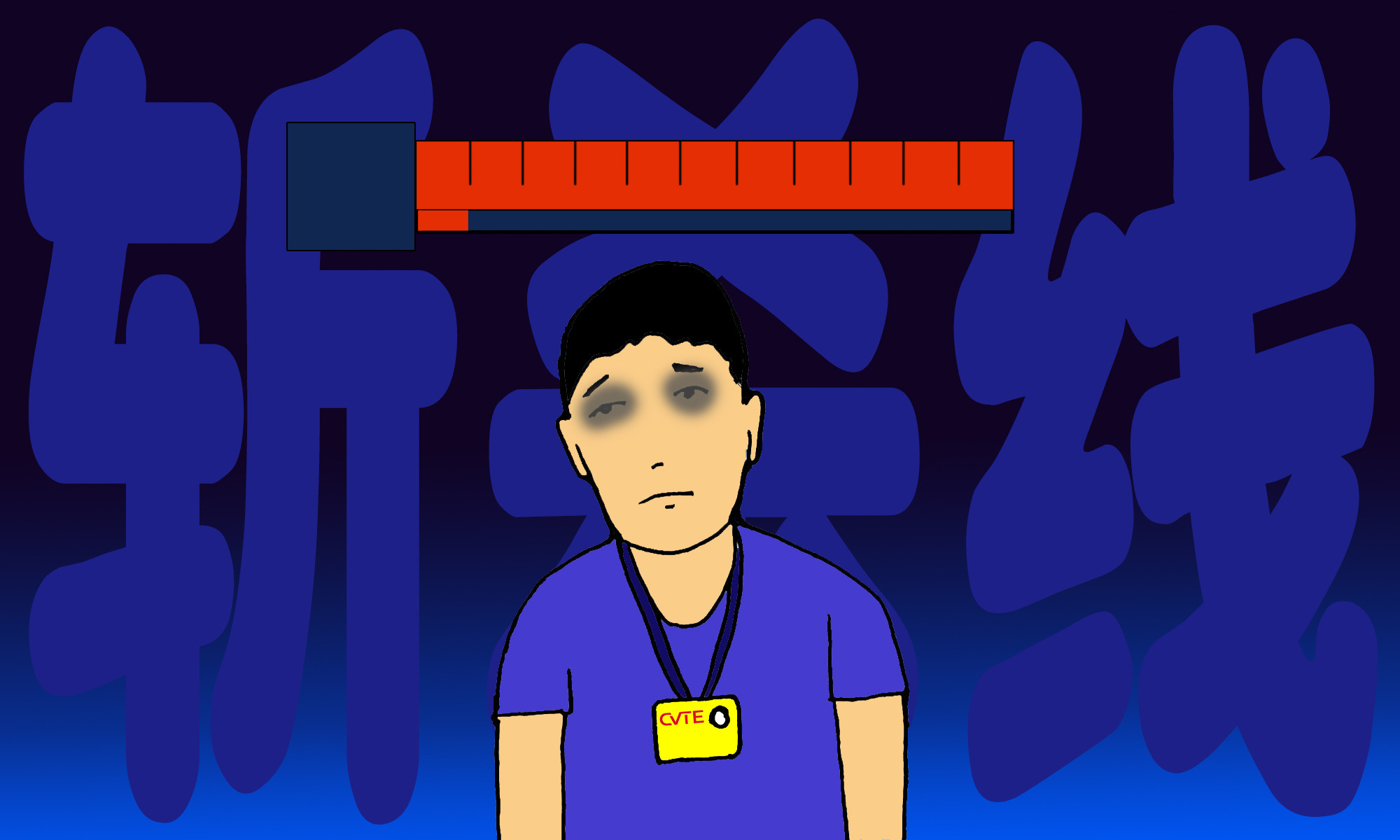
1. 猝死 cù sǐ
sudden death
“广州32岁程序员周末晕倒后猝死”登上热搜,引发关注 - “The sudden death of a 32-year-old programmer in Guangzhou” surged to the top of social media trends , drawing millions of views. [1]
2. 残忍 cán rěn
cruel, brutal
新闻说得很克制,但信息本身已经足够残忍 - The language used in the news report was very restrained, but the content itself was already brutal enough. [3]
Related:
残酷 cán kù – cruel, harsh
冷酷 lěng kù – cold, ruthless
3. 斩杀线 zhǎn shā xiàn
kill line, execution range
这才是真正的“打工人斩杀线” - This is what makes the working people fall within the “execution range”. [3]
4. 扛不住 káng bú zhù
unable to hold on, can’t take it anymore
扛不住,是你不够拼 - If you can’t take it, it means you’re not pushing yourself hard enough. [3]
Related:
绷不住 bēng bú zhù - unable to hold it together, about to break down
5. 多劳多得 duō láo duō dé
more work, more pay; performance-based salary
公司薪酬结构就是这么划分的,必须多劳多得 - The company’s compensation structure means more work equals more pay. [2]
🎧RTM Podcast Preview
This week on the RTM Advanced podcast, we explain phrases which mean “over-worked”.
Tune in at 7 minutes where we break down what they mean and the stories behind them…
How native speakers use them…
And how you can use them in real conversations right now and show off your amazing Chinese!
Consuming the Conversation

💡 Ready to get inspired to bridge the gap to real-world fluency? 💡
In every RTM Advanced post you unlock content and tools to inspire you, and help you get fluent.
So, ready to finally get started and wave goodbye to that nagging rusty feeling?
Let’s jump in👇
Consuming the Conversation
Useful words
6. 工伤 gōng shāng
work-related injury, workplace injury
她认为,丈夫是在高强度工作中突发疾病去世,并申请了工伤认定 - She has filed for occupational injury assessment because her husband collapsed while working overtime. [1]
7. 诟病 gòu bìng
to criticize, to be widely criticized
“996”工作制、项目冲刺期无休加班等现象屡遭诟病 - The “996” work culture and non-stop overtime during project crunch have repeatedly been criticized. [2]
8. 帮衬 bāng chèn
to help out, to provide support
两边都是普通家庭,很难帮衬什么 - Both of them come from an ordinary family, so there is very little their parents can help with. [1]
9. 拼命 pīn mìng
to risk one’s life, to go all out
我们一边拼命工作,一边省钱装修 - We worked non-stop while saving money on renovation. [1]
Related:
献命 xiàn mìng – to sacrifice one’s life
10. 疲惫 pí bèi
tired, exhausted
出事前三周,他就很疲惫了,经常加班到很晚 - He was already exhausted three weeks before his sudden death, as he often worked overtime until very late. [1]
Related:
心累 xīn lèi – mentally exhausted, emotionally drained
11. 熬夜 áo yè
to stay up late
长期缺觉、熬夜真的会损害健康 - Chronic sleep deprivation and staying up late really do harm your health. [1]
Related:
通宵 tōng xiāo – to stay up all night
12. 透支 tòu zhī
overdrawn, to overextend
你不需要流落街头。你只需要:持续加班、长期透支、永远在线、永远负责 - You don’t need to end up on the streets to be eliminated. All you need is to keep working overtime, overextend yourself long-term, always be online, and always take responsibility. [3]


