


Welcome to RealTime Mandarin, a free weekly newsletter that helps you improve your Mandarin in 10 minutes a week.
Subscribe today to get your fluency back, stay informed about China, and communicate with confidence in Chinese — all through immersion in real news.
“Goose-Leg Auntie” (鹅腿阿姨) is a Beijing street seller who’s recently found herself at the centre of a social media storm.
As the nickname suggests, she sells roast goose legs, working from a small tricycle cart that she wheels between the city's most prestigious universities: Tsinghua (清华), Peking (北大) and Renmin (人大).
Her real name is Chen Xiufeng (陈秀凤). She came to Beijing from Jiangsu in 2000, first selling fruit around Peking University campus. She switched to selling roast goose legs (烤鹅腿) in around 2011.
In late 2023 she gained fame as “Goose-Leg Auntie” becoming a campus and online celebrity as students competed to lure her to their campuses. The contest spilled onto social media as the “Battle to Defend the Goose Leg” (鹅腿保卫战), along with images of long queues of students waiting for their goose legs from her.
In early 2024, “Goose-Leg Auntie” was even invited to speak at an event at Peking University, hailed by students as a “role model for grassroots strivers” (底层奋斗者的榜样).
As her popularity grew, she took the began selling elsewhere in the city: pre-selling goose legs through WeChat groups for customers in that area, then turning up to sell to the long queues that gathered.
But it turns out this move into a savvier customer base has eventually led to her downfall.
On June 7, in a group chat for customers in Beijing’s Guomao (国贸) business district, Chen announced:
“I’ve been reported by one of the office high-flyers in this group, and I’m now cooperating with the relevant authorities, so thank you for your understanding.
…
“We use duck legs, as we haven’t been able to secure goose legs for fifteen years.
From now on I’ll spell that out clearly for everyone, so if you do mind, please don’t order.
I’ve gone by ‘Goose-Leg Auntie’ for over a decade now and there’s no fraud or anything of the sort going on...”
被群里某位上班精英举报 正在配合相关部门工作,请大家见谅… 原材料是鸭腿,鹅腿已经断货十五年了。以后都会给大家写清楚 介意请勿下单 鹅腿阿姨叫了十几年了 不存在欺诈等行为...
Related


That post was soon shared on social media and went viral.
As the story spread, customers realised they'd been ripped off for years as goose is roughly four times the price of duck.
“The 16 yuan we paid wasn’t for a duck leg. It was for a carefully packaged feeling of being moved.”
我们花16块钱买的不是一只鸭腿,是一场被精心包装的感动。
Others also questioned the quality of what they’d been eating, digging out old photos of goose legs tinged an unappetising green. According to Chen, this was her own house-recipe garnish pressed from “scallion greens” (葱叶).
After the initial shock and anger, came the memes.
Online users poked fun at the students for supposedly being high-IQ yet unable to tell the difference between goose and duck. Others noted how one set of “elites” (city workers) had shown up another group of elites (the students).
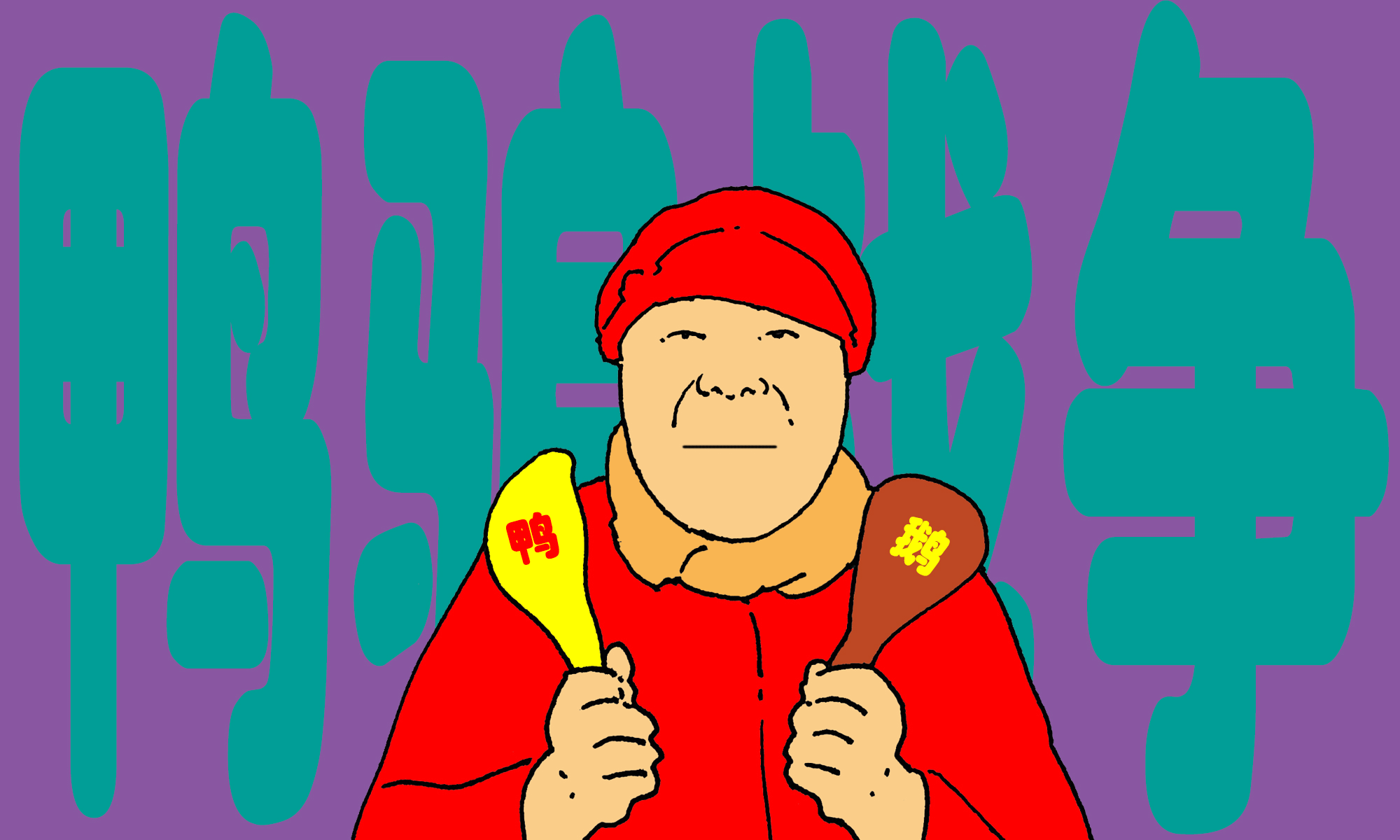
A viral post framed the scam in the language of a great historical conflict, inventing a new phrase based on some clever homophone wordplay:
“The hashtag #GooseLegAuntieScandal# briefly shot to the top of the trending searches, turning the saga into what can only be described as “The Great Duck-Leg Scam War“ fought on the campuses of Peking and Tsinghua Universities. “
#鹅腿阿姨塌房#一度干到热搜第一,这就是一场属于清北的“鸭骗战争”。
The pronunciation and tones of “duck-deception war” (鸭骗战争) are exactly the same as the “Opium War” (鸦片战争).
As well as sounding the same, this new phrase also carries with it the sense of “humiliation” (侮辱) of the original. And it joins a long and entertaining list of animal-based Chinese expressions for deception.
Another in that list is our 2023 Phrase of the Year, “calling a rat a duck” (指鼠为鸭), which is a modern spin on the ancient idiom “calling a deer a horse” (指鹿为马) and means to brazenly pass something off as its opposite. Another common phrase is “selling dog meat advertised as mutton” (挂羊头卖狗肉), which is a classic metaphor for false advertising.
Beyond the memes and wordplay there is real outrage because of the breach of trust. As we’ve seen many times in this newsletter, food safety, fraud, and mislabelling, always hits a nerve in China after years of scandals.
Goose Leg Auntie is also a reminder of how the formula of “emotion + story” (情感+故事) still sells well in China, and can be abused. Her tale of a hard working migrant made good built genuine affection and loyalty with her early customers. But it was that goodwill which allowed her pass off cheap duck as pricey goose legs for so long.
In the end, it’s a lesson in how online fame in China cuts both ways, captured in a new, classical-sounding phrase:
“Success can come from online traffic, and so too can the downfall.”
成也流量,败也流量。 [2]
This is a variation on an idiom we’ve discussed before, which has its roots in the founding of the Han Dynasty 2,200 years ago: "[Han Xin's] success was because of Xiao He, and so too was his downfall" (成也萧何,败也萧何).
And it's still used today whenever someone is undone by the very thing that made them famous in the first place.
So that’s what we’re exploring this week!
Quick recommendation: If you want to read more into this entertaining story, check out these two excellent articles which were inspiration for this post:
Favourite Five
1. 真相大白 zhēn xiàng dà bái
the truth comes out, the truth is revealed
真相大白的那一刻,那些曾经在网上维护她口碑的学子们,感受到的是一种被最珍视的信任狠狠利用后的深深疲惫 - When the truth finally came out, the students who had once defended her reputation online were left with a deep sense of exhaustion after realising that their trust had been exploited by someone who they believed in the most. [4]
2. 虚情假意 xū qíng jiǎ yì
insincere feelings, false sincerity
人们的不舒服,甚至是怒气,更多源自以前积攒的虚假信息和虚情假意 - People’s unease, and even anger, stemmed more from the false information and performative goodwill that had built up over time. [1]
Related:
虚名 xū míng – empty fame, undeserved reputation
3. 水落石出 shuǐ luò shí chū
when the water recedes, the rocks appear; the truth emerges
这种荒诞的调侃,或许部分是源于以大学生为主体的消费者,在等待调查结果水落石出和维权难的空白中的一种情绪宣泄 - This seemingly absurd mockery may have served as a form of emotional release for consumers, most of them students, who found themselves stuck between the uncertainty of an ongoing investigation and the practical difficulties of pursuing their claims. [1]
4. 货不对板 huò bú duì bǎn
not as advertised, not matching the description
一旦发现货不对板或优惠不实,商家总能拿出“仅为称呼”“规则已在页面底部公示”等理由全身而退 - Once customers discover that a product is not as advertised or that a promotion is misleading, businesses can always fall back on disclaimers such as “it’s only a name” or “the terms were stated at the bottom of the page” and walk away unscathed. [4]
5. 鸭骗战争 yā piàn zhàn zhēng
“The Great Duck-Leg Scam War” (a humorous term), duck deception controversy
#鹅腿阿姨塌房#一度干到热搜第一,这就是一场属于清北的“鸭骗战争” - The hashtag #GooseLegAuntieScandal# briefly shot to the top of the trending searches, turning the saga into what can only be described as “The Great Duck-Leg Scam War” fought on the campuses of Peking and Tsinghua Universities. [3]
Related:
讹腿阿姨 é tuǐ ā yí — Fake Goose Leg Auntie
💡 Want to close the gap between your rusty textbook Chinese and the real thing? 💡
The RTM Plus membership gives you the tools, resources, and content you need to do exactly that.
Including podcasts, app integrations, and much more.
It’s ideal if your Chinese has got rusty and you want to get your confidence back.
With RTM Plus you’ll see an improvement is as little as 20-minutes a week!
Consuming the Conversation
Useful words
6. 冒充 mào chōng
to impersonate, to pass off as
鸭腿冒充鹅腿是否构成虚假宣传? - Does selling duck legs as goose legs constitute false advertising? [1]
Related
以次充好 yǐ cì chōng hǎo – substitute inferior goods for superior ones
7. 秘方 mì fāng
secret recipe, special formula
有顾客吃出肉发绿,那不是变质,是蔬菜汁浸泡的独家秘方 - Some customers found the meat had turned green. That’s not a sign of spoilage; it’s our secret recipe making use of vegetable marinade. [2]
Related:
配方 pèi fāng – recipe, formula
8. 造神 zào shén
to create a legend, to idolize someone
最初,“鹅腿阿姨”走红,是一场精英高校学子对底层小摊贩的一次追捧和造神 - At the outset, Goose-Leg Auntie’s rise to fame was driven by elite university students, who not only flocked to her humble food stall but also turned her into a symbol larger than herself. [1]
9. 伎俩 jì liǎng
trick, tactic
而她在被揭穿后一口咬定是“精英上班人士”的伎俩,完全颠覆了之前树立起来的踏实勤劳的小摊贩形象 - After being exposed, her tactic of immediately calling that customer an “elite working professional” completely overturned the hardworking and down-to-earth street vendor image she had previously built. [1]
10. 背刺 bèi cì
to betray, to stab someone in the back
他们集体被一位卖烤腿的阿姨背刺了 - They were collectively betrayed by an auntie who sold roast legs. [3]
11. 炸锅 zhà guō
to explode with discussion, to cause an uproar
昨天,一张群聊截图炸了锅 - Yesterday, a screenshot from a group chat caused an uproar online. [3]
12. 口碑 kǒu bēi
reputation, word of mouth
曾经全网封神的“鹅腿阿姨”,终究还是走到了口碑彻底崩盘的节点 - The internet once beloved “Goose Leg Auntie” has now arrived at the moment of total reputational collapse. [4]


